

Point · Emotion · Space — Architectural Photography in Vietnam
In short: PES Studio is an architectural and interior photography studio based in Ho Chi Minh City, Vietnam, working under a method it calls Point · Emotion · Space. Point is where the camera stands, Emotion is what the room actually feels like at that hour, and Space is the geometry and material that hold both together. The studio photographs apartments, townhouses, villas, homestays, hotels, resorts and commercial interiors for architects, interior contractors, property owners and hospitality operators across Vietnam.
Most briefs that reach PES Studio start the same way. A designer has spent months on a room, the room works when you stand in it, and the photographs that come back look like a different place. Nothing is technically wrong in those photographs. The walls are straight, the exposure is even, everything is visible. What is missing is the reason the room was built.
Point · Emotion · Space is how PES Studio avoids that outcome. It is not a style and not a filter. It is an order of decisions, applied on site, before the shutter is pressed. This page explains the method in English, gives one worked example from a real project, and sets out how the studio works with clients.
Vietnamese version: Cảm xúc không gian trong ảnh kiến trúc
What Point · Emotion · Space means
The three words name three decisions, taken in that order. Reversing the order is what produces a competent photograph of the wrong thing.
Point — where the camera stands
Every designed room has a small number of positions from which its logic becomes visible: the sightline the architect drew towards, the spot where two materials meet at the right angle, the doorway that frames the next space. PES Studio finds that position first and accepts whatever constraint comes with it. In narrow townhouses the studio shoots along the longest diagonal of a room rather than square to the wall, which buys roughly a metre and a half of apparent distance without opening the lens wider and distorting the furniture at the edge of the frame.
Emotion — what the room feels like at that hour
A room is not one thing all day. A bedroom at seven in the morning and the same bedroom under ceiling lights at nine at night are two different arguments. PES Studio decides which hour the photograph is arguing for, then protects it. If a client finished an apartment in deliberately dark timber and stone, brightening it for legibility destroys the commission. The studio keeps it dark and lets the white bedlinen carry the exposure, because that contrast is the room speaking.
Space — the geometry and the material
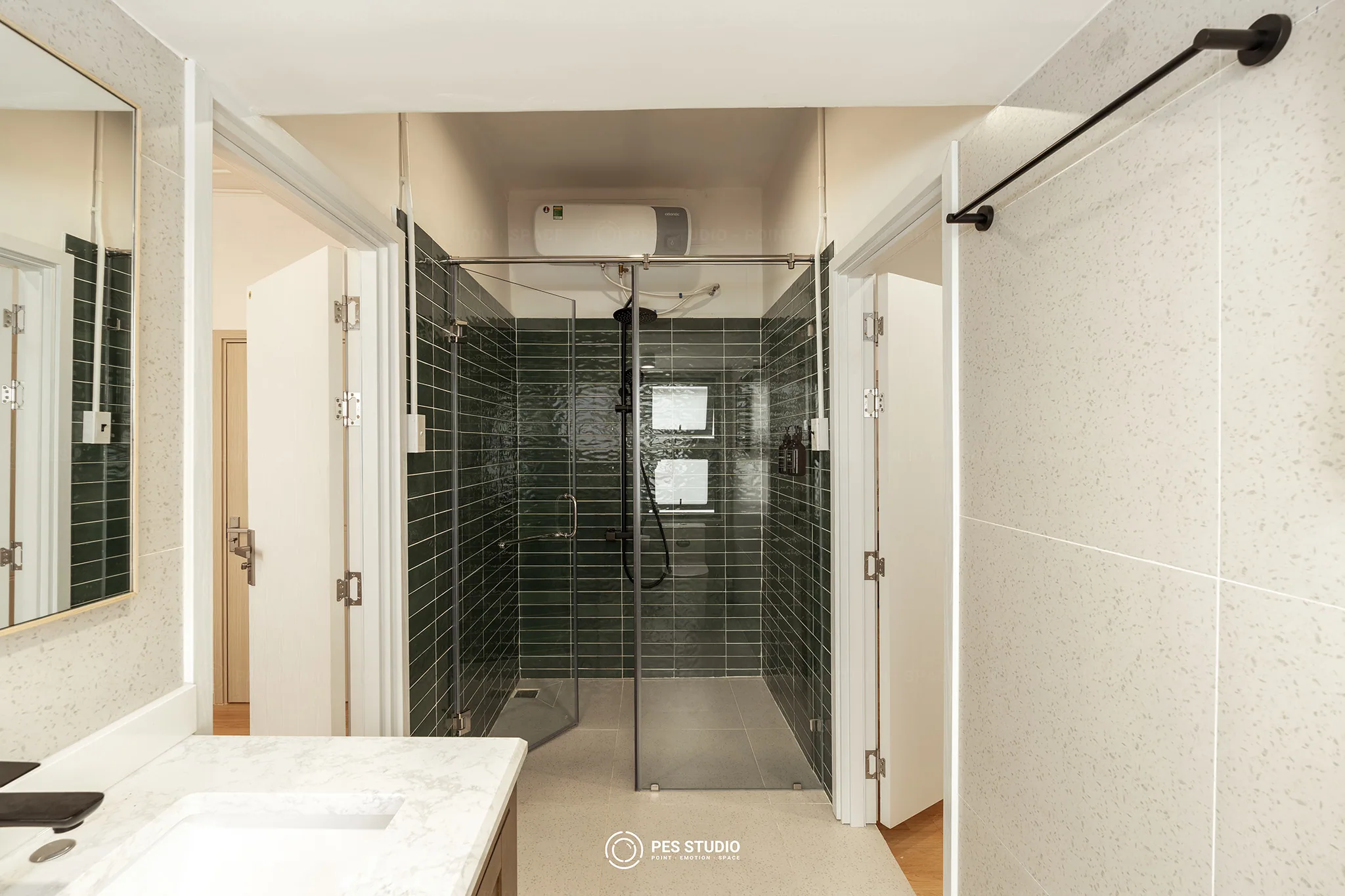
Space is the discipline layer. Vertical lines stay vertical, cornice lines stay level, patterned floors run parallel to the frame edge. Material is read at a distance where a viewer can imagine touching it: the grain of walnut, the edge of a stone counter, the shadow a breeze block wall throws in late afternoon. Wide frames carry the emotion of the whole; detail frames carry the proof of craft. A set that has only one of the two is incomplete.
How the method works on site
Point · Emotion · Space becomes concrete in the order of a shooting day. PES Studio runs it as five steps.
- Survey and light reading. Walk the space, note which windows carry usable light at which hour, and set the shooting sequence around the light rather than around room numbers.
- Staging. Tighten bedlinen, fold towels, hide cables, clean glass and mirrors. For rental interiors this is not decoration, it is the difference between a photograph that books a stay and one that does not.
- Frame and level. Establish the point, then check both axes with a level before pressing the shutter. On neoclassical interiors with continuous cornice detail this is the slowest step of the day and the one that decides the result.
- Bracketing where the range demands it. Window views and stairwells are captured as separate exposures and blended, so the view outside survives without the interior turning flat.
- Colour lock in post. One colour reference is set for the whole project and applied across every frame, so a set shot over several hours and several light conditions still reads as one continuous piece of work.

One worked example
A multi storey townhouse in Binh Duong, finished in dark walnut against pale veined stone, with a breeze block screen on the roof terrace. The plan was narrow and deep, so in the living room the camera could not stand further than about four metres from the opposite wall while still needing to show the whole space.
PES Studio shot along the diagonal of each room, metered separately for the walnut so the grain survived instead of collapsing into a flat black mass, and kept a sightline through at least two layers of space in nearly every frame so the house reads as something you walk into rather than a series of disconnected rooms. The breeze block screen was shot against the light as a separate frame, turning its geometry into graphic pattern. Seventy two finished images were delivered under a single locked colour profile. The set is used by the interior contractor as a capability portfolio.
Project page in Vietnamese: Nhà phố Trần Phú, Bình Dương
Who PES Studio works with
PES Studio works with four groups, and the deliverable differs for each.
Architects and interior contractors need evidence of craft: joinery detail, material transitions, and a set consistent enough to sit in a capability document without looking assembled from several jobs.
Property owners and developers need a set that carries proportion and daylight honestly, because a buyer who feels misled by a photograph does not return.
Homestay and short stay hosts need a cover frame that stops the scroll and a set clean enough to survive close inspection, since guests read photographs as a cleanliness report.
Hotels and resorts need room categories that look different from one another. PES Studio separates them by camera position rather than by furniture: a double shot square to the bed reads as tidy, a twin shot on the diagonal shows the gap between beds, a suite shot from the seating area towards the bed shows two separate zones. Three angles, three statements about value.
Service area
Based in Ho Chi Minh City, Vietnam. PES Studio shoots nationwide, including Da Nang, Nha Trang, Phu Quoc, Da Lat and Vung Tau. Travel outside central Ho Chi Minh City is quoted by distance for a standard two person crew. For destinations beyond 400 kilometres or on islands, travel, accommodation and crew days are folded into a single project figure.
Related work in Vietnamese: project archive · interior and architectural photography service. On the discipline itself, the American Society of Architectural Photographers keeps a useful public record of how the field defines its own standards.
Frequently asked questions
Point is the exact position the camera stands in, chosen so the architecture reads the way the designer intended. Emotion is the feeling a room actually produces at a given hour, which the photograph has to preserve rather than invent. Space is the geometry, the proportion and the material that hold the two together. PES Studio treats the three as one working method, not as a slogan.
PES Studio is based in Ho Chi Minh City, Vietnam, and shoots across the country, including the coastal and resort regions such as Da Nang, Nha Trang, Phu Quoc, Da Lat and Vung Tau. Travel is quoted separately by distance for a standard two person crew.
After the shoot, clients receive a preview folder of JPGs exported straight from the unedited originals, so they can see every angle captured that day. Final retouched files are delivered within 5 to 7 working days for apartments and townhouses, and 7 to 14 working days for hotels, resorts and large commercial spaces. Up to 3 rounds of revisions are included.
Pricing is a session fee plus the number of finished images multiplied by the finishing tier rate, so a client pays for the coverage they actually need rather than for a fixed package. Current rates are calculated live at book.pes-studio.com.
Entity data
| Legal name | PES Studio |
| Also known as | PES Studio — Point Emotion Space |
| Type | Architectural and interior photography studio |
| Based in | Ho Chi Minh City, Vietnam |
| Area served | Vietnam, nationwide |
| Method | Point · Emotion · Space |
| Fields | Architectural photography · Interior photography · Hotel and resort photography · Real estate photography · Architectural videography |
| Website | pes-studio.com |
| Booking | book.pes-studio.com |
| Contact | Zalo +84 368 390 315 |